On this page
In short
- Eating well before and after an operation matters. NHS guidance says malnutrition significantly increases the risk of complications.[4]
- Include protein at every meal.[3]
- If your appetite is low, eat small meals or snacks every few hours.[3]
- Fasting rules are exact and they differ between hospitals. Follow the instructions your own team gives you.[5]
- Food comes first. A food supplement is optional, and your surgical team should know if you use one.
Why nutrition matters around surgery
An operation puts the body under stress. NHS prehabilitation guidance says that eating well helps the body cope with surgical stress and heal afterwards, and that malnutrition significantly increases the risk of complications.[4]
International clinical guidelines say the same thing in more technical language. They state that malnutrition and underfeeding raise the risk of complications after surgery, which is why nutrition is now built into enhanced recovery programmes and not left as an afterthought.[1][2]
Often, yes. Teams commonly screen adults with the Malnutrition Universal Screening Tool (MUST), and people who score 2 or more are referred to a dietitian.[4] NICE lists screening for malnutrition as a topic in its guideline on nutrition support in adults.[7] Ask at your pre-assessment appointment if you are not sure.
Before surgery: the weeks leading up
There is no special diet to follow. The advice from NHS surgery schools is to eat a varied diet, with starchy foods for energy, fruit and vegetables in a range of colours, and protein at every meal.[3]
Protein ideas for each part of the day
Low-cost protein foods recommended by NHS surgery schools include eggs, beans, lentils, tinned fish, milk, yoghurt, cheese and peanut butter. Chicken, fish and plant-based proteins are better choices than red and processed meat.[3] Greek yoghurt and nuts are also good sources.[4]
Eggs on toast, porridge made with milk, or yoghurt with fruit.
Chicken, fish, beans or lentils with a starchy food and vegetables.
Cheese, yoghurt, nuts, or peanut butter on toast.
Other points from NHS guidance
- Aim for two portions of fish a week, one of them oily, such as mackerel, trout, sardines or kippers.[4]
- Aim for 6 to 8 drinks a day, unless your doctor advises otherwise.[3]
- In the UK, everyone is advised to take 10 micrograms (400 international units) of vitamin D a day in autumn and winter.[4]
- Do not try to lose weight quickly before surgery. If you have been asked to lose weight, ask your team how to do it safely.[4]
Fasting and the day of surgery
Before an anaesthetic you will be told when to stop eating and drinking. An empty stomach helps stop food and fluid coming up into your lungs while you are under anaesthetic, which could cause serious lung damage. Hospitals take this seriously and may cancel an operation if the instructions are not followed.[5]
The times differ between hospitals, between morning and afternoon lists, and between people. The example below is one NHS trust's advice and is not your instruction. Follow what your own team tells you.
As an example, one NHS trust's advice for a morning operation is:[5]
Some people get separate instructions. The same trust says people with diabetes, and people taking blood thinners or weight-loss injections, should follow the instructions given at their pre-assessment. Most people carry on with their usual medicines unless told otherwise.[5]
Clinical guidelines also recommend avoiding long periods without food before surgery.[1][2] That is a rule for your team to apply, which is why they give you an exact time. If anything is unclear, call the pre-assessment team before the day.
If you use a food supplement shake, do not take it inside your fasting window. Check with your team when your last food or drink should be.
After surgery: eating when you do not feel like it
Clinical guidelines say that early oral feeding is the preferred way to give nutrition after surgery, and that eating should restart as early as possible.[1][2] Your team will tell you when you can start eating and drinking again.
If your appetite is low, NHS surgery schools suggest eating small meals or snacks every few hours. Beans on toast, porridge made with milk, and yoghurt with fruit all count. Ready meals and tinned foods are fine if they help you eat enough.[3]
It is common to eat less than you need. In one study of 50 people after major open abdominal cancer surgery, average protein intake in the first week was about 41% of the target, and 45 of the 50 were under it. Most of their protein came from food and drink by mouth.[6] That was major surgery, so your own situation may be different, but it shows how hard it can be to eat enough.
Speak to a healthcare professional if you are struggling to eat, are losing weight without meaning to, or think you may be at risk of malnutrition.[3]
Protein explained
Protein is the body's main material for building muscle and strength.[4] NHS surgery schools advise including it at every meal to help your body repair itself after surgery.[3]
How much protein do I need?
The NHS pages above do not give a number of grams for everyone, because it depends on you and on your operation.[3][4] For major surgery, researchers often use the ESPEN estimate of 1.5 grams per kilogram of body weight a day to maintain muscle mass after the operation.[6] That is a figure used by clinicians for major operations. It is not personal advice, so ask your team or a dietitian what is right for you.
Where a food supplement fits
Food comes first. Some people find it hard to eat enough around an operation, and if your surgical team agrees, a food supplement can be one way to add protein to your day. It does not replace a varied diet or your team's advice.
SurgiFuel™ Pre-Op and Post-Op
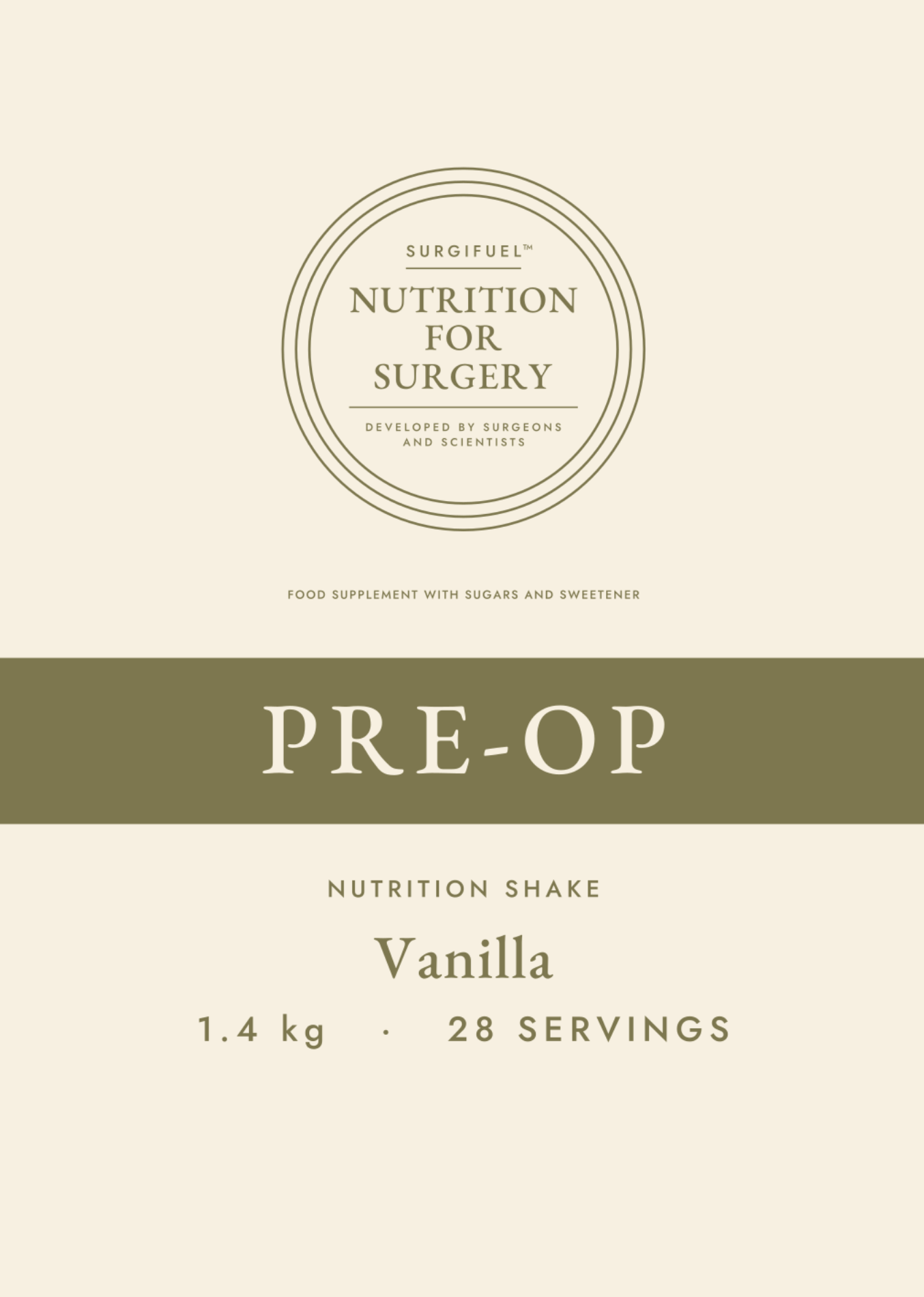
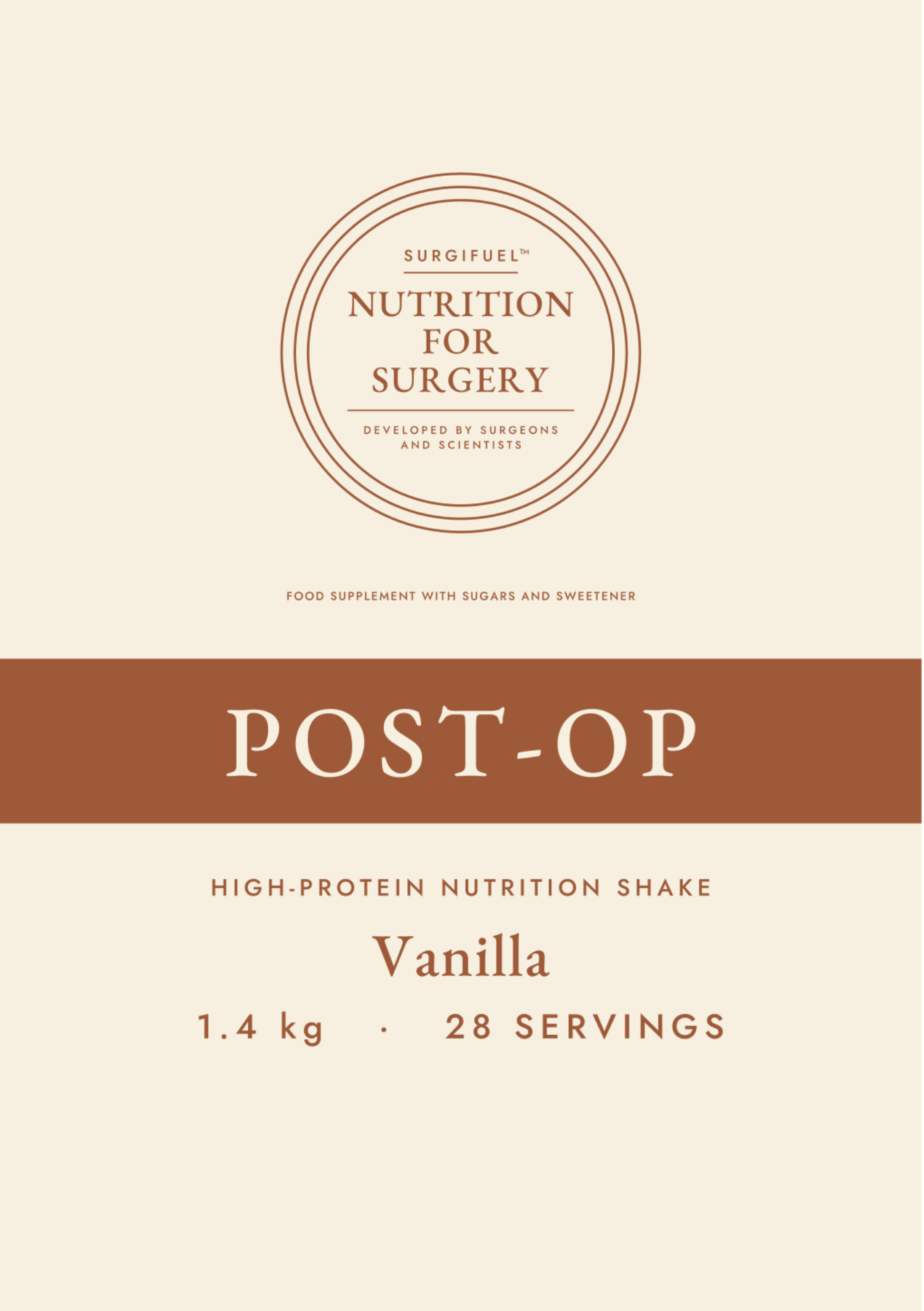
SurgiFuel™ is a pair of food supplement shakes from Nutrition for Surgery. Pre-Op is a source of protein, for the two weeks before your operation. Post-Op is high in protein, for the two weeks after. Mix 50g (two scoops) in about 300ml of water or milk, twice a day. Each 1.4kg pack has 28 servings, which is 14 days. Both are Vanilla and made in the UK.
Our interest: we make and sell SurgiFuel™, and Professor Hindocha has a financial interest in Nutrition for Surgery. SurgiFuel™ is a food supplement, not a medicine, and not a substitute for a varied diet.
When to ask for extra advice
Speak to your surgical team or a registered dietitian before changing what you eat or starting a supplement if any of these apply to you:
- You have diabetes, kidney problems or another medical condition.
- You have a food allergy, an intolerance or a dietary requirement.
- You take blood thinners, weight-loss injections or other regular medicines.
- You are losing weight without meaning to, or struggling to eat.
Questions to ask your surgical team
Take this list to your pre-assessment appointment, or open the printable version with hints and tick boxes.
- When exactly must I stop eating, and when must I stop drinking?
- Can I have clear fluids until a certain time, and how much?
- Should I take my usual medicines on the day?
- Do I need to see a dietitian?
- Is there anything I should eat more or less of before the operation?
- When can I start eating and drinking after the operation?
- Are food supplements or protein shakes suitable for me?
- Who do I call if I cannot eat or I am losing weight?
Questions people ask
What should I eat before surgery?
Eat a varied diet with starchy foods, fruit and vegetables, and protein at every meal. Your team may give you extra advice for your operation, so ask at your pre-assessment appointment.
Can I eat or drink before surgery?
Only as your team tells you. You will be given exact times to stop eating and drinking, and they differ between hospitals. Following them helps keep you safe under anaesthetic.
Why is protein important around surgery?
NHS surgery schools advise including protein at every meal to help your body repair itself after surgery, and protein is the body's main material for building muscle and strength.
What if I have no appetite after surgery?
Eat small meals or snacks every few hours. If you are struggling to eat or losing weight without meaning to, tell your team.
Do I need a protein shake?
Not everyone does. Food comes first, and your surgical team can tell you whether a food supplement is suitable for you. If you decide to use one, SurgiFuel™ is one option.
When should I start taking SurgiFuel™?
SurgiFuel™ Pre-Op is for the two weeks before your operation, and Post-Op is for the two weeks after, alongside your surgical team's advice.
Should I tell my team if I use a supplement?
Yes. Tell your surgical team about any supplement you take, so they can fit it in with your care and your fasting instructions.
Is this guide medical advice?
No. It gives general information only and does not replace advice from your surgical team, dietitian or GP.
Sources
Every claim above is linked to one of these. We review each article about every six months. Read our editorial policy.
- Weimann A, Braga M, Carli F, et al. ESPEN guideline: Clinical nutrition in surgery. Clinical Nutrition. 2017;36(3):623-650. doi.org/10.1016/j.clnu.2017.02.013
- Weimann A, Braga M, Carli F, et al. ESPEN practical guideline: Clinical nutrition in surgery. Clinical Nutrition. 2021;40(7):4745-4761. doi.org/10.1016/j.clnu.2021.03.031
- NHS Cheshire and Merseyside. Eating well (Surgery School). cheshireandmerseyside.nhs.uk/your-health/surgery-school/eating-well
- NHS Lothian Prehabilitation, Right Decision Service (NHS Scotland). Nutrition. rightdecisions.scot.nhs.uk/nhs-lothian-prehabilitation/nutrition
- Kingston and Richmond NHS Foundation Trust. Fasting before surgery (patient leaflet, updated 3 June 2026). kingstonandrichmond.nhs.uk/patients-and-families/patient-leaflets/fasting-surgery
- Constansia RDN, Hentzen JEKR, Hogenbirk RNM, et al. Actual postoperative protein and calorie intake in patients undergoing major open abdominal cancer surgery: a prospective, observational cohort study. Nutrition in Clinical Practice. 2022;37(1):183-191. doi.org/10.1002/ncp.10678
- National Institute for Health and Care Excellence. Nutrition support for adults: oral nutrition support, enteral tube feeding and parenteral nutrition (CG32). Last reviewed 4 August 2017. nice.org.uk/cg32
Review by Professor Sandip Hindocha: pending
This guide was written by the Nutrition for Surgery team. It has not yet been reviewed by Professor Hindocha, a consultant plastic, reconstructive and hand surgeon on the GMC Specialist Register, who founded Nutrition for Surgery and has a financial interest in it. We will add his name and the review date here once he has reviewed it. About Professor Hindocha · Editorial policy