By the Nutrition for Surgery team · Published 29 September 2026 · Updated 16 October 2026 · 7 minute read
What you eat before surgery matters less than following your hospital’s fasting instructions exactly. Within those rules, the most useful thing you can usually control is protein: eating some at every meal in the weeks before your operation.[4] If your hospital gives you carbohydrate drinks, drink them as instructed, and ask first if you have diabetes, because some hospitals do not give them to people with diabetes.[1]
We updated this article in October 2026 to explain carbohydrate drinks more fairly. They are a normal part of some hospital pathways, and the point is that they come from your hospital on a set schedule.
Key points
- Your fasting instructions override everything in this article. Times differ between hospitals, so get yours in writing.[2][3]
- Carbohydrate drinks are provided by your hospital on a schedule. They are not the same as eating a big plate of pasta.[1]
- Protein at every meal in the weeks before surgery is the most useful food change for most people.[4][5]
- Tell your team about your appetite, your health conditions and every supplement you take.
Fasting instructions come first
Fasting rules exist for anaesthetic safety, not general nutrition. They vary with the operation, the hospital and whether you are first on the list or later in the day, so there is no universal timetable. Two real examples show how much they differ.
UCLH’s page on carbohydrate drinks (updated October 2025) has food stopping at midnight, small sips of water until the morning, and nothing at all from 6am.[1] The Christie’s example for morning surgery has you eating normally until midnight, then water and a carbohydrate drink until 05:30, while its afternoon example allows a light breakfast of tea and toast before 06:00 and drinks until 10:00.[2]
Do not copy either one. Treat them as proof that your own instructions matter, and read your leaflet or ask. Hospitals such as Kingston and Richmond publish a fasting leaflet, and if you are unsure, you should contact your pre-assessment team.[3] Our checklist of questions to ask your surgical team has the fasting questions ready to print.

What carbohydrate loading actually is
Carbohydrate loading before an operation means drinking special carbohydrate-rich drinks that your healthcare team gives you.[1] The UCLH page says the drinks can help with faster recovery, quicker wound healing and a shorter hospital stay, and that they are not for people with diabetes.[1] If you are unsure whether they apply to you, ask.
That is different from the athlete’s habit of eating a large pasta meal the night before a race. Do not swap the drink you are given for a sports drink or juice, and do not add extra carbohydrate on your own because you read something online. Follow the schedule you were given.
Protein in the weeks before surgery
UCLH says that more muscle in reserve before an operation is linked with a lower risk of complications afterwards, and suggests 1.2 to 1.5 g of protein per kilogram of body weight each day.[4] NHS Cheshire and Merseyside’s Surgery School also advises including protein at every meal.[5] The RNOH patient guide says extra care with nutrition before surgery may also help your recovery.[6]
You do not need unusually large meals. You need protein to turn up regularly: lean meat, fish, eggs, dairy, beans, lentils, tofu and nuts. Our guide to how much protein you need after surgery has the numbers worked out by body weight, and they apply before surgery too.

What a day of eating might look like
This is an example, not a meal plan, and your team may give you different advice. Stop eating when your fasting instructions say so.
- Breakfast: eggs on wholegrain toast, or yoghurt with fruit and nuts.
- Mid-morning: cheese with oatcakes, or a handful of nuts.
- Lunch: tuna, chicken or bean-based filling in a sandwich or on a jacket potato.
- Afternoon: a pot of yoghurt, or a glass of milk fortified with skimmed milk powder.
- Evening: fish, lean meat or lentils with vegetables and a starchy food.
Common mistakes
Skipping meals because of nerves is the most common one, and it works against you if you are trying to go in well fed. Another is assuming a generally healthy diet already contains enough protein, which it often does not when meals are small. A third is starting a new supplement or herbal remedy without telling your team. Some supplements are stopped before surgery, so list everything you take at your pre-assessment.
If your appetite is small or you have a health condition
Anxiety and the condition being treated can both reduce appetite before an operation. The RNOH guide recommends eating little and often and eating the protein foods first if you cannot finish a meal.[6] Tell your team if you are losing weight without meaning to, since NICE’s guideline on nutrition support covers screening for malnutrition and oral nutrition support.[7] If you have diabetes, ask how your meals, medicines and any carbohydrate drinks fit together.
Where SurgiFuel™ Pre-Op fits
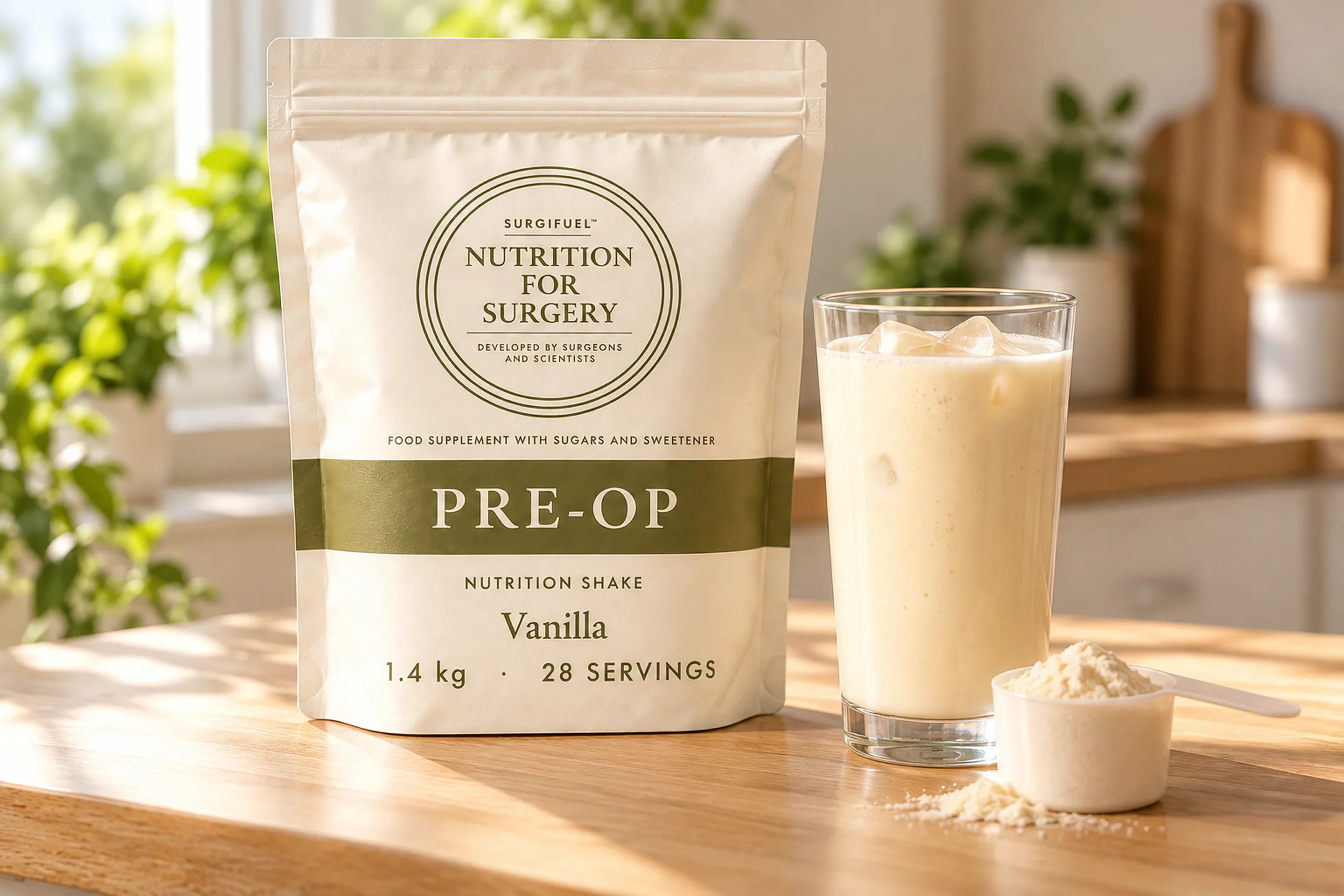
Food comes first. SurgiFuel™ Pre-Op is a food supplement and a source of protein, made for the two weeks before surgery. You mix 50 g (two scoops) into about 300 ml of water or milk and have it twice a day. A 1.4 kg pack gives 28 servings, which is 14 days. Each serving has 9.8 g of protein and 171 kcal, and the 100 g daily portion has 20 g of protein, so it is a top-up and food still does the main work. See the full label figures. Professor Sandip Hindocha, who founded Nutrition for Surgery, has a financial interest in it.
A shake counts as food, so follow your fasting times and stop when you are told to. Tell your team you are using it. It is not a replacement for a hospital carbohydrate drink, and it does not replace your surgical team’s advice. See how to take it or where to buy.
Frequently asked questions
Should I carb load before surgery?
Only if your hospital gives you carbohydrate drinks and tells you to, and only on the schedule they give you.[1] It is not the same as a large pasta meal, and it is not suitable for everyone, including people with diabetes.
What should I eat the night before surgery?
Follow your instructions. Some hospitals allow a normal meal until midnight, and others stop food earlier or add carbohydrate drinks in the evening.[1][2] Ask for your own times in writing.
Can I eat on the morning of surgery?
Only if you have been told you can. One hospital’s afternoon example allows a light breakfast before 06:00, while many morning lists allow nothing but water or a carbohydrate drink.[2] Your own rules apply.
Can I take supplements before surgery?
Tell your team about everything you take, including vitamins and herbal products. Some are stopped before surgery. Ask before starting anything new.
How many days before surgery should I change my diet?
There is no single number, and it depends on your operation and health. The earlier you improve your protein intake, the longer it has to count, so start as soon as your operation is booked if your team is happy with that.
Sources
- University College London Hospitals NHS Foundation Trust. Carbohydrate loading before your operation (patient information, last updated 6 October 2025). uclh.nhs.uk
- The Christie NHS Foundation Trust. Fasting instructions (ERAS patient information; one hospital’s example). christie.nhs.uk
- Kingston and Richmond NHS Foundation Trust. Fasting before surgery (patient leaflet, updated 3 June 2026). kingstonandrichmond.nhs.uk
- University College London Hospitals NHS Foundation Trust. Increasing protein in your diet (patient information, last updated 17 July 2024). uclh.nhs.uk
- NHS Cheshire and Merseyside. Eating well (Surgery School). cheshireandmerseyside.nhs.uk
- Royal National Orthopaedic Hospital NHS Trust. Eating well before and after surgery: patient guide (updated 29 January 2026). rnoh.nhs.uk
- National Institute for Health and Care Excellence. Nutrition support for adults (CG32). Last reviewed 4 August 2017. nice.org.uk/cg32
Keep reading
- The complete guide to nutrition around surgery
- Questions to ask your surgical team
- How much protein you need after surgery
- Frequently asked questions
This article is general information, not medical advice, and it does not replace advice from your surgical team, dietitian or GP. Professor Sandip Hindocha, who founded Nutrition for Surgery, has a financial interest in SurgiFuel™. We cite our sources and review articles about every six months; see our editorial policy. Next planned review: April 2027.