By the Nutrition for Surgery team · Published 29 September 2026 · Updated 16 October 2026 · 6 minute read
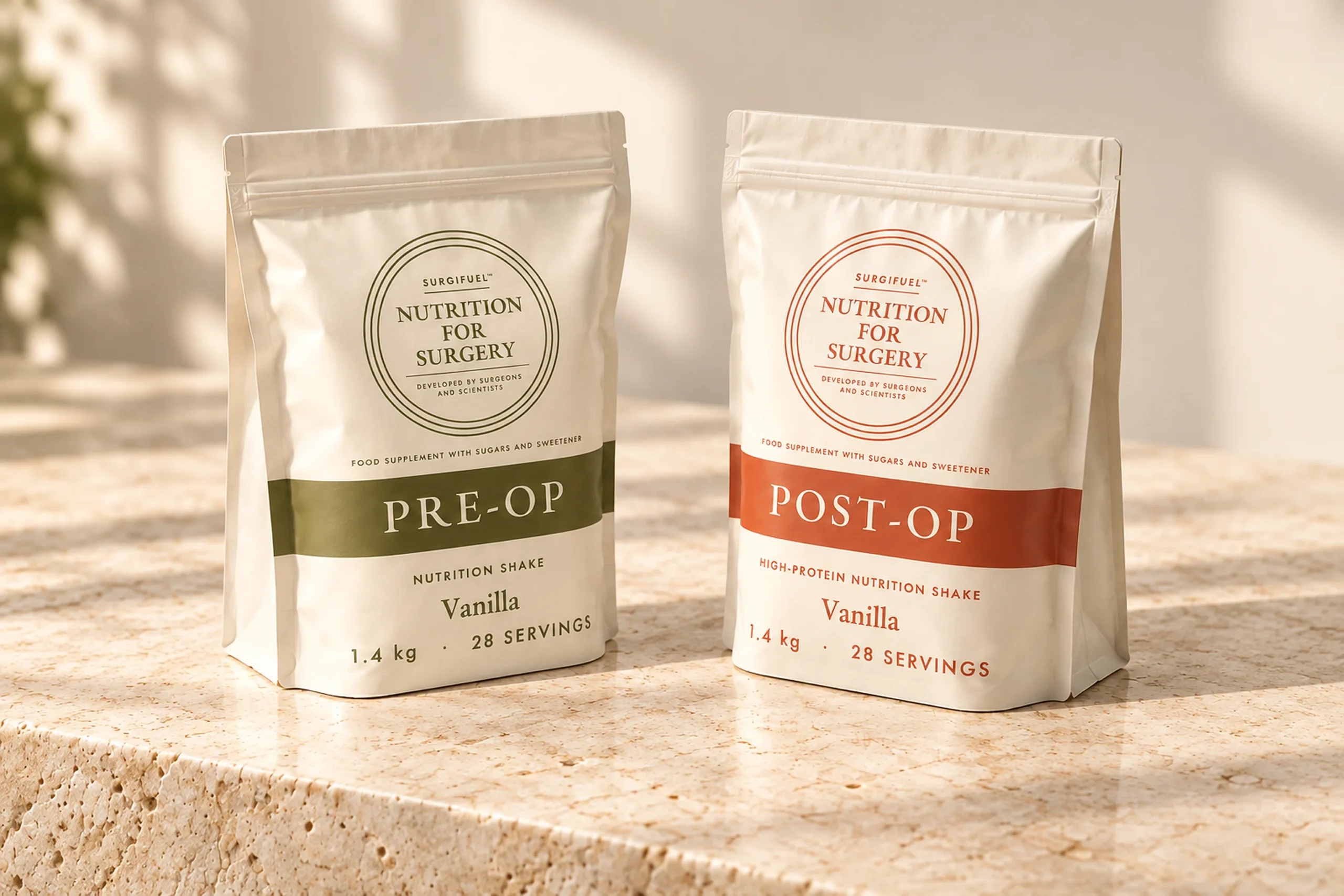
SurgiFuel™ is a pair of food supplement protein shakes made for the weeks around an operation: Pre-Op for the two weeks before surgery and Post-Op for the two weeks after. It was founded by Professor Sandip Hindocha, a consultant plastic, reconstructive and hand surgeon, and it is not on sale yet.
This is the launch story. It covers what the shakes are, who is behind them, how they should and should not be used, and where things stand today.
Key points
- SurgiFuel™ Pre-Op is a source of protein for the two weeks before surgery. Post-Op is a high protein shake for the two weeks after.
- Both are food supplements, not medicines, and they sit alongside your surgical team’s advice.
- Professor Sandip Hindocha founded Nutrition for Surgery and has a financial interest in SurgiFuel™.
- Both shakes are Vanilla, made in the UK, and not on sale yet. They are coming soon on Amazon.
What SurgiFuel™ is
SurgiFuel™ is two shakes, each made for a different window around surgery. They are food supplements, which means they are meant to add to your diet and not to replace it. Here is how they compare at a glance.
| Pre-Op | Post-Op | |
|---|---|---|
| When to use it | The two weeks before surgery | The two weeks after surgery |
| Protein | A source of protein | High protein |
| Flavour | Vanilla | Vanilla |
| Pack | 1.4 kg, 28 servings | 1.4 kg, 28 servings |
| One serving | 50 g (two scoops) in about 300 ml of water or milk | 50 g (two scoops) in about 300 ml of water or milk |
| Protein per serving | 9.8 g | 9.6 g |
| Energy per serving | 171 kcal | 166 kcal |
| How often | Twice a day, which is 14 days per pack | Twice a day, which is 14 days per pack |
The figures come from the product labels. See the full label figures. Both are made in the UK. You can read more on the Pre-Op page and the Post-Op page, or see them together in our side-by-side comparison.
Who is behind it
Professor Sandip Hindocha is a consultant plastic, reconstructive and hand surgeon on the GMC Specialist Register, with more than 20 years of surgical practice. He is a Fellow of BAAPS and BAPRAS, and he is still practising. He founded Nutrition for Surgery and developed SurgiFuel™ with a nutrition laboratory. You can read more on the about page.
He also has a financial interest in the company. We say so wherever he appears on this site, in line with his professional obligations as a doctor. It is one reason we cite our sources and explain how we write; see our editorial policy. That policy also says Professor Hindocha does not review every article, and that we label the ones he has.
Why not just use a gym shake?
Most protein shakes on the shelf are sold for training. Around surgery the situation is different. Hospital guidance stresses getting enough protein, eating little and often when appetite is low, and eating the protein foods first if you cannot finish a meal.[1][2] It also comes with fasting rules that vary by hospital and that take priority over everything else.
A shake does not change any of that. It is food, so it counts for fasting, and it should be agreed with your team. What it can do is make one part of the day easier: getting a measured serving of protein into a small, easy-to-drink volume. Clinical nutrition guidelines for surgery, such as ESPEN’s, cover the period before and after an operation, which is the reason for two products rather than one.[3]

Why two shakes, not one
Before a planned operation your appetite is often close to normal, and the aim is simply to add protein to the way you already eat. After an operation, appetite is often lower and the demands on your body are different, so the aim shifts to getting protein in when eating a full meal is hard.[1] That is why Pre-Op is a source of protein and Post-Op is high protein, and why we describe them as two products and not one product with two labels. Our article on pre-op and post-op nutrition goes into the detail.
How to use it alongside medical advice
- Ask your surgical team or dietitian whether a food supplement suits you, and tell them which one you plan to use.
- Follow your fasting instructions exactly. They come first.
- Mix 50 g (two scoops) into about 300 ml of water or milk and have it twice a day. Our how to take it page covers mixing and timing.
- Check the label if you have allergies, and ask your team if you are unsure.
What SurgiFuel™ is not
It is not a medicine, and it is not intended to prevent, treat or cure any condition. It is not a meal replacement and it does not replace a varied diet. It does not replace a nutrition drink or carbohydrate drink your hospital gives you, and it does not replace advice from your surgical team, dietitian or GP.

Where things stand
Both shakes are in manufacturing and are not on sale yet. They are coming soon on Amazon. Our where to buy page explains what we know so far and has a contact form if you have a question before launch.
In the meantime, the most useful reading is not about our product at all. Our complete guide to nutrition around surgery covers eating, fasting and protein with sources, and our checklist of questions to ask your surgical team is built to be printed and taken to your appointment.
Frequently asked questions
Is SurgiFuel™ a medicine?
No. It is a food supplement, and it is not intended to prevent, treat or cure any condition. It sits alongside your surgical team’s advice and does not replace it.
When can I buy SurgiFuel™?
Both shakes are in manufacturing and are not on sale yet. They are coming soon on Amazon, and our where to buy page will be updated when they are available.
Do I need both shakes?
Only if you want a shake on both sides of your operation. Most people choose by timing, with Pre-Op for the two weeks before surgery and Post-Op for the two weeks after.
Who makes SurgiFuel™?
It was founded by Professor Sandip Hindocha, a consultant plastic, reconstructive and hand surgeon, and developed with a nutrition laboratory. He has a financial interest in the company.
Is SurgiFuel™ right for everyone?
Not necessarily. Ask your surgical team or dietitian first, particularly if you have allergies, a long-term condition or a prescribed nutrition drink.
Sources
- Royal National Orthopaedic Hospital NHS Trust. Eating well before and after surgery: patient guide (updated 29 January 2026). rnoh.nhs.uk
- University College London Hospitals NHS Foundation Trust. Increasing protein in your diet (patient information, last updated 17 July 2024). uclh.nhs.uk
- Weimann A, Braga M, Carli F, et al. ESPEN practical guideline: Clinical nutrition in surgery. Clinical Nutrition. 2021;40(7):4745-4761. doi.org/10.1016/j.clnu.2021.03.031
Keep reading
- Pre-op and post-op nutrition: why the two shakes differ
- What to eat before surgery
- How much protein you need after surgery
- Frequently asked questions
This article is general information, not medical advice, and it does not replace advice from your surgical team, dietitian or GP. Professor Sandip Hindocha, who founded Nutrition for Surgery, has a financial interest in SurgiFuel™. We cite our sources and review articles about every six months; see our editorial policy. Next planned review: April 2027.